noticing/seeing
03/20/2026
noticing
Barthes likes to cite his friends. In the introduction to A Lover’s Discourse he distinguishes between ordinary, insistent, and occasional readings, conversations with friends, and his own life, then flattens them into reference:
“I am not invoking guarantees, merely recalling, by a kind of salute given in passing, what has seduced, convinced, or what has momentarily given the delight of understanding (of being understood?).” (9)I took a picture of this passage and sent it to Joyce, who is a friend I often am referencing, who told me to read this book, which I probably would have spent a long time “getting around to” if not for the desire to understand why she liked it. She said she had never really noticed that part.
Still Pictures, which is Janet Malcom’s last book and only memoir (she was extremely suspicious of the genre) has a lovely posthumous introduction by one of her friends. In it, he writes about her interest in his persistent Christianity— that he would call her after church every week to relate the sermon, so he could hear her questions about it.
“On the occasional Sunday morning when I found it hard to get out of bed, I roused myself anyway. When I did miss a Sunday, I sensed her disappointment; she made me a more faithful attendee than I might have been.” (xiv)
There was a long time where Hellie found it very hard to resist taking a picture of the light breaking on one face of a building. When I’m on walks with her, and when I’m not, I notice it and stop, even though she doesn’t take that picture quite as often anymore. All this to say it is always richly rewarding to notice, but infinitely easier to do so with love asking you to look.
seeing
Earlier today Elio let Hellie and I into the Art Institute to see Sanctus, a short by Barbara Hammer they have installed in the video gallery. It plays on a loop: we came in a little over halfway through, and sat very still and watched very closely while it finished, and started over, and finished again. The film is (I think) hand-colored optical printing of (I know) James Sibley Watson’s x-ray films. He was an avant-garde amateur who became a doctor and spent 20 years perfecting capturing x-ray imaging through filming some 10,000 patient exams. His wikipedia page does not make clear how the patients felt about this. He is part of a long tradition of doctors with the tinkerer’s spirit chasing a proliferation of images that were supposed to calcify into a higher form of vision, which sometimes produces a breakthrough, but is more often reinventing phrenology, or doing nothing at all.
Medical imaging operates at the edge of vision. The x-ray is a fantasy of perfect sight: that we can go inside the body without damaging it, that it can communicate unmediated by observation. This time last year I had just read Beatriz Colomina’s X-Ray Architecture, which is a history of the x-ray through the kinds of sight fantasies it produces. She talks about its life as a novelty technology, about the blithe radiation damage done by use in beauty pageants and shoe fittings.
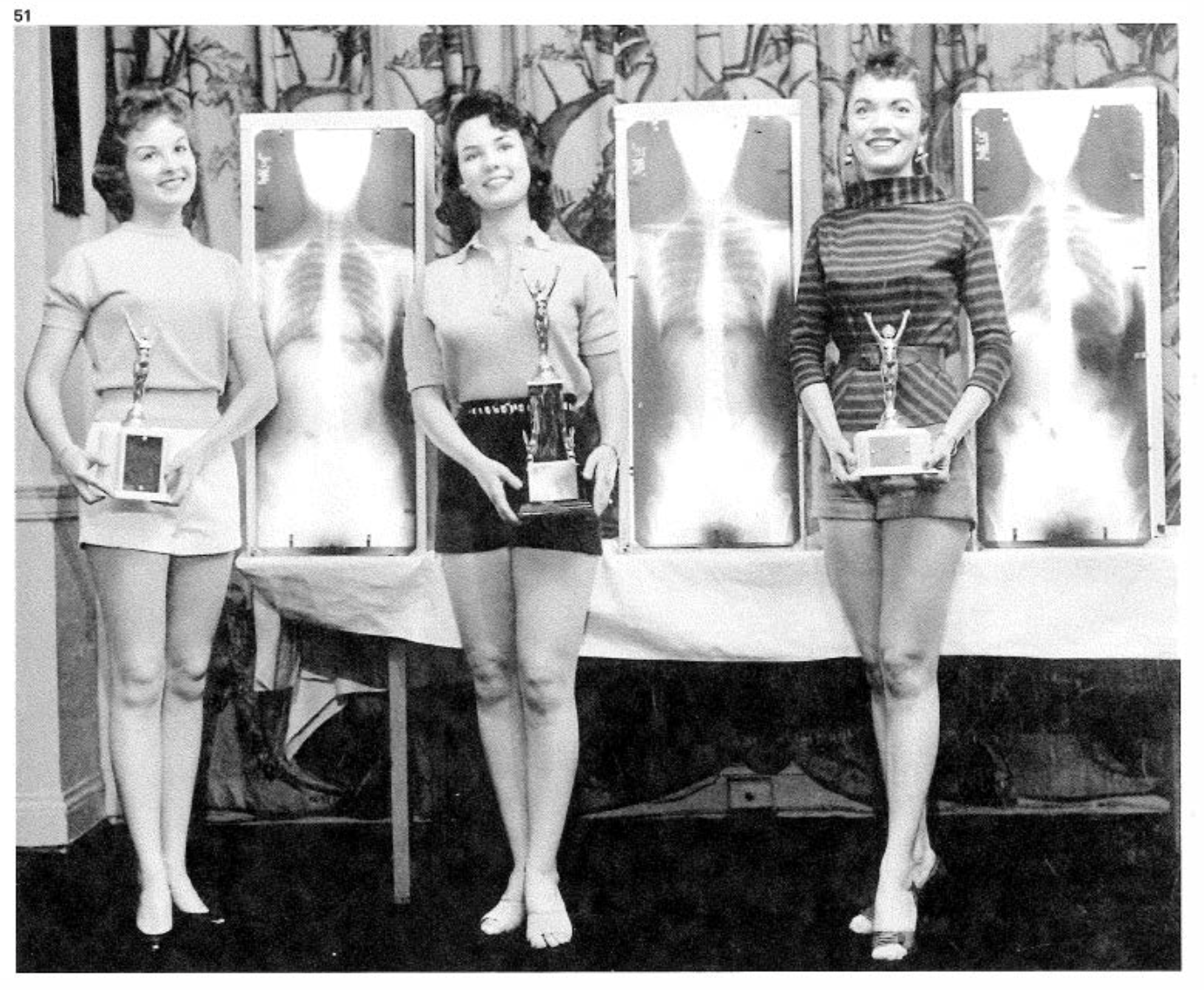
(Miss Correct Posture, Chicago, 1956, as pictured in Life magazine)
She writes about one of Watson’s x-ray films, made for Kodak Research Laboratories in 1937, advertising the technology’s virtues for disease prevention over footage of healthy patient exams. The narrator exclaims:
“This young lady, to whom henceforth a glass house should hold no terrors, will after an examination of her radiographs, be reassured that she is indeed physically fit.
The image will tell you what experience will not. The body’s transparency will locate it more firmly in healthy reality.
It is terrifying to see inside your body without an interpreter’s eye: it is dehumanizing to develop one, to reconfigure a patient as an image. Cancer can eat your body for a long time before you notice the holes: if you look at a bone scan, they’ll tell you you can’t see anything unassisted, that you don’t know how big the holes are regardless of how their contours appear to you.
In Sanctus, only the bones are solid, flesh coming into and out of vision only by gap, implication, twist. In profile, a hand presses against the face, moving up and down: the nose appears as an invisible distance. The forehead is nothing at all, skull pushing directly against skin. In the dark in the gallery I could feel my organs and they made me sick. I wondered if they were full of holes I don’t know about yet. The imaging of my mother’s lungs shows noise. A studied eye can only find ambiguity. Something has to grow, for them to be sure. Her bones are full of holes, though: even I can see that.
currently reading (in order of how actively):
listening to:
watching: